
Video Tutorial Program
The I&M Society offers a selection of Video Tutorials (VTs) that address relevant and important topics of interest to the I&M community. Video Tutorials are classified as belonging to the Expert or Classroom series. Video Tutorials of the Expert series are authored by someone who is recognized as an Expert (academician or practitioner) in his/her field, while a Classroom series Video Tutorial is one typically authored by a graduate student and may be geared more towards specific measurement or instrumentation skills and/or classroom-based lecture topics.
The I&M Society also offers the opportunity to earn CEU/PDH credits. Interested in submitting a tutorial? Please see below for more information.
If you have any questions, please contact the Editor-in-Chief of the Video Tutorials Program for more information.
Video Tutorials Program Editor-in Chief
-

Sabrina Grassini
AffiliationPolitecnico di TorinoCountryITAIEEE RegionRegion 08 (Africa, Europe, Middle East)Email
-
Sabrina Grassini
AffiliationPolitecnico di TorinoCountryITAIEEE RegionRegion 08 (Africa, Europe, Middle East)Email
Video Tutorial Previews
-
 Webinar
Electrical Resistance Tomography for 2D and thin-film materials: from measurements to image reconstruction
PresenterDate -
 Webinar
The Supportive Smart Home: Solutions Enabling Independence - Ambient Sensing, Artificial Intelligence in Ethical Context
PresenterDate -
 Webinar
Basic and Straightforward Approach to Optimize a Measurement Set-up: Guidelines and Suggestions
PresenterDate -
 Webinar
Optical Biosensors for Point-of-Care Test (POCT) devices
PresenterDate -
 Webinar
How Information Theory Helps Sensing Design
PresenterDate -
 Webinar
Quantifying Uncertainty in Machine Learning-Assisted Measurements
PresenterDate -
 Webinar
Wearable Sensors for Cardiorespiratory Monitoring: From Design to Data Analysis
PresenterDate -
 Webinar
Human Response to Vibration Measurement and Assessment of Risk
PresenterDate -
 Webinar
The Measurement of the Electromagnetic Properties of Materials Using Transmission Line Techniques
PresenterDate -
 Webinar
Medicine 4.0: AI and IoT, the New Revolution
PresenterDate -
 Webinar
A Gentle Introduction to DOE (Intro)
PresenterDate -
 Webinar
Non-invasive Monitoring of Drugs Bioavailability by Tissue Impedance Measurement
PresenterDate -
 Webinar
Charge Measuring Electronics in Medical Applications (Intro)
PresenterDate -
 Webinar
Electrical Capacitance Tomography- from Principle to Applications (Intro)
PresenterDate -
 Webinar
Measurement of Magnetism in Composite Materials (Intro)
PresenterDate -
 Webinar
Measurements Applications for Autonomous Systems (Intro)
PresenterDate -
 Webinar
Signal Quality- From Wearables to Hospitals (Intro)
PresenterDate -
 Webinar
What is Impedance and Dielectric Spectroscopy? (Intro)
PresenterDate -
 Webinar
Design and Characterization of Measurement Systems Based on Drone
PresenterDate -
 Webinar
Measurements for Smart(er) Grids
PresenterDate -
 Webinar
Principals and Applications of Near Infrared Spectroscopy
PresenterDate -
 Webinar
Single-Photon Detection Using Avalanche Gain in Silicon
PresenterDate
Other Tutorials
Abstract: An accurate, realistic digital model of a physical object can be created by collecting the 3D coordinates of a sufficient number of points of the object surface and by identifying the 3D surface which approximate these points. This process is called 3D scanning. This tutorial will present the physical principles and the techniques that can be used for capturing the geometry and the visual properties of real objects. The characteristics of the scanning devices will be analyzed, with particular attention to their accuracy, their speed, and the practical issues related in their use. A taxonomy of the major devices available on the market and in the literature will be presented with a critical, comparative evaluation of the benefits and limits.
Abstract The tutorial explains what are ADC and DAC, why they are important in our daily lives and why there is the demand for ADC and DAC standardized metrology. Then, the overview of ADC and DAC existing standards is presented highlighting the open questions to be solved in this field, too.
Scope: The tutorial titled ‘Calibrating a Vector Network Analyzer (VNA)’ outlines the process of completing a full two-port calibration on a Vector Network Analyzer. The tutorial assumes that the viewer is already familiar with the VNA and its capabilities. Topics discussed include basic VNA settings, different types of calibrations, calibration kits, and finally the process necessary to complete a full two-port calibration.
Abstract: The tutorial titled ‘Characterizing a 2-, 3-, and 4-port Device’ discusses the process necessary to characterize a 2-, 3-, and 4-port microwave/high frequency device using S-parameter measurements. The tutorial assumes the viewer is familiar with basic Vector Network Analyzer (VNA) operation and basic microwave S-parameter characterization principles. The tutorial outlines the additional components necessary (match loads, thru adapters, etc), and provides a step-by-step connection procedure for each of the three types of devices.
Abstract: No abstract currently available.
Abstract: The road between an academic proof-of-concept and the actual commercial product is long and difficult. Many bright ideas that demonstrate a usable proof-of-concept die on the road to commercial realization. Many reasons exist for really good ideas failing to become viable commercial products, a few include: funding to cover effort, lack of real market research, and luck. This tutorial will touch each of these topics. The goal is to give you some practical insights into avoiding pitfalls and to increasing your chances of success.
Abstract: Data acquisition Part 1 - Introduction This tutorial introduces you to the fundamentals of instrumentation and measurement. You should learn the following objectives: - the need for measurement, - the basic principles of measurements, - the basic components or subsystems of a measurement instrument, - block diagrams of the various architectures for instrumentation.
Data acquisition Part 2 - Definitions, Design, and Architecture This tutorial, part 2 in the series, should help you understand: • some basic definitions for sensors. • the basic principles of sampling and anti-alias filtering. • and the calculations to estimate the noise and signal-to-noise ratio for sensors and analog-to-digital converters.
Data acquisition Part 3 - Analog-to-Digital Converters This tutorial, part 3 in the series, should help you understand: - how to select an appropriate analog-to-digital converter for use in a sensor. - some of the basic shortcomings of analog-to-digital converters. - and some tests for analog-to-digital converters.
Abstract: Real-world applications often confront the designer with unusual requirements not readily apparent in the classroom. Many environmental sensing applications are, or could be, battery powered. Part B of the ENVIRONMENTAL SENSING AND MEASUREMENTS presentation begins by discussing the desirability (and advantages) of reducing power consumption to an absolute minimum. A specific design example involving a lengthy string of many temperature sensors in an industrial application illustrates the consequences of apparently innocuous power consumption decisions to system architecture and, by extension, to the operating life of a battery-powered system. The presentation then reviews U.S. NOAA Cooperative Observer Program siting requirements for temperature measurements typical of those used in weather reporting, and shows how a truly robust design must also anticipate little-discussed non-electronic issues (such as mud daubers, fire ants, rodents, snakes, and cattle looking for a convenient scratching post).
Abstract: At nanoscale dimensions, materials can exhibit entirely new properties associated with quantum physical phenomena. Manufacturers are seeking to use these properties for applications in nanoelectronics, semiconductors, smart materials, biotechnology, alternative energy sources, and many more. In many of these applications, nanotechnology researchers often need to measure extremely small currents and voltages—measurements that are typically difficult to perform accurately. This presentation discusses the challenges associated with measurements of nanoscale materials and devices and how to minimize the effect of a variety of error sources.
Abstract: Optical sensors and photonic devices have technically matured to the point that they are increasingly considered as alternatives for their electronic counterparts in numerous applications across the industry. In particular, the utilization of optical sensors has been considered for harsh or explosive environments where conventional transducers are difficult to deploy or where their operation is compromised by electromagnetic interference. This tutorial will explain the motivation for research on fiber-optic sensors, highlight the basic theories underlying their operation, and present selected examples of R&D projects targeting a range of industrial applications. The goal is to highlight great potential of optical sensors and to enrich your experience in instrumentation and measurement using alternative, non-electronic methods.
Abstract: The last 5 years has seen increasing interest in the use of synchronized clocks in distributed system architectures. This is a direct result of the achievable synchronization performance using protocols such as IEEE 1588 and the availability of commercial silicon and infrastructure supporting these protocols. This video will provide an overview of the operation and the performance of IEEE 1588 and a discussion of existing and potential applications of IEEE 1588.
Abstract: Noise affects most devices. Designing adequate shielding does not have to be a black art – in fact, it should not be. Some basic understanding and applying appropriate principles will eliminate most problems. The tutorial first describes the various mechanisms of noise – understanding them will give you immediate insight into avoiding noise problems. Next it covers issues in grounding. Finally, it provides basic design tips and techniques to diagnose problems and select the appropriate shielding.
Abstract: This tutorial gives a short presentation of the measurement concept. It starts from the analysis of the different possible measurement applications and their impact on the everyday life. To prove that measurements have always been a great part of the social life, it offers a short historical digression showing that some of the modern metrology needs were well understood at the time of the Roman Empire, and shows how the concept of measurement standards has evolved along time. At last, it shows the impact of measurements on today life, providing also an economical estimate of the overall measurement cost and presents the fundamental issue of today metrology: the expression and evaluation of measurement uncertainty.
Abstract: Near infrared spectroscopy (NIRS) is an optical technique that allows investigating tissue hemodynamics in-vivo and non-invasively by measuring optical absorption properties of oxy- and deoxy-hemoglobin using near infrared light (650-1000 nm). Since its introduction more than forty years ago, NIRS has seen a tremendous research growth due to its unique combination of performance, portability and reduced cost in comparison to other imaging techniques such as functional magnetic resonance imaging (fMRI) or positron emission tomography (PET). Importantly, NIRS has also been adopted in the clinical setting as a reliable technique for monitoring cerebral oxygenation in critical care, and many other scientific and clinical applications are rapidly developing. This tutorial introduces the basic principles of NIRS and briefly describes some of the most relevant applications in the field.
Abstract: Product design requires tradeoffs in many different areas: - Circuit design - Cooling - Power - Software - Buy vs. build - Manufacturing - Diagnostics, repair, and maintenance This tutorial introduces some design tradeoffs that you will need to consider during development of hi-tech products; actually it is more like a “key hole” view of how some products come to market. It will focus on 11 case studies and how they made these design tradeoffs. This will hopefully give you a deeper appreciation and understanding how you might go about designing and developing products.
Abstract: This tutorial surveys sensor technologies and sensing systems for currently perceived security applications. Since its content is based entirely on information available in the open literature, it is possible that one or more important but still-secret approaches are not covered. It begins by considering high-level categories: sensors for things and "stuff" vs. sensors for people. In the sensors for "stuff" category bulk -- mostly physical -- and vapor -- mostly chemical -- techniques are surveyed. The best-known "airport security" techniques are examined: several x-ray methods, microwave back scattering, and neutron activation in the physical category, and ion mobility spectrometry in the chemical category. Several distinctions are made for sensing people: finding, identifying, and verifying their claimed identities. Identification and verification techniques surveyed include face, hand, ear, finger, iris, retina, and vein-based systems.People-finding techniques surveyed include thermal imaging and, evaluating it as an anticipated future technology, terahertz radiation imaging.
Abstract: The tutorial introduces the main concepts of standardization to understand what is a standard and how it can be defined. In order to understand how standards are delivered, the existing standardization levels as well as the ideal and actual standardization processes are discussed, too.
Abstract: This video tutorial analyzes strain gauges and their main parameters along the required signal conditioning. Some mathematical models are analyzed to identify the dependence of influencing quantities (temp, strain, etc..) on geometrical parameters. The video also includes a brief overview of the main materials used and their advantages and drawbacks. At the end, an experimental test is performed.
Abstract: This tutorial covers the most fundamental issue of measurements: how can we assess how good the results of our measurements are? To do so, the tutorial presents a model of the measurement process and identifies the main sources of inaccuracy and discusses their effects on the final result, proving that expressing any measurement result with a single number and a measurement unit is meaningless. The tutorial discusses the ways for assessing how good a measurement result is and shows why the old, traditional concept of measurement error is inadequate and should be abandoned. It defines and discusses the modern uncertainty concept and gives an overview of the possible ways it can be evaluated, according to the recommendations of the IEC-ISO Guide to the Expression of Uncertainty in Measurement (GUM). A few practical examples are provided. At last, the limitation of the GUM approach is shortly discussed.
Abstract: In this tutorial we provide an introduction to physical sources of random noise and some of the history of random noise. Then we consider ways of using random noise to measure physical constants; ways of using random noise to measure circuit parameters; and ways of using random noise to encrypt data. Finally we consider a method of using pseudo-random noise to measure circuit parameters and to encode data.
Abstract: In outdoor applications, wireless sensor networks must be rugged and resistant to degradation from fouling, moisture, and human interference. Ease-of-use is important for setup by users of widely varying technical backgrounds working under extreme conditions. The data should be traceable to its originator, and should be made available in a format compatible with online collections for use by the largest number of researchers. This tutorial will cover strategies for sensor protection, plug-and-play sensor setup, and data extraction. The goal is to give insights from practical experience, and to make connections between cutting-edge research and real-world environmental sensing needs.
Creating a Video Tutorial
Video Tutorial Package Content
A video tutorial will address a topic of specific interest for the IEEE Instrumentation and Measurement (I&M) Society. The video tutorial will be presented by one or more authors.
Video tutorials will be stored and managed by the Society. Each Video Tutorial package will consist of the following items:
- The Video Tutorial itself, in .MP4 format
- A list of keywords
- A short author’s CV
- A Consent and Release form, signed by the author(s) of the Video Tutorial. The author(s) of the video are defined as the speaker(s) of the material within the video (not others who may have contributed to the development of the topic). Video Tutorials will not be published without a signed Consent and Release form.
- The author(s) have the option to also include an Assessment Quiz, in .doc format, consisting of 10 multiple choice questions with 4 possible answers for each question. Correct solutions must also be included. The Assessment Quiz will be used for interested viewers to earn CEUs/PDHs after successful completion of the quiz. A Video tutorial can be published if the author(s) choose to not submit a quiz.
Video Tutorial Submission Process
A video may be submitted, at any time, by interested author(s) or can be invited by the Editor-in-Chief (EIC). The final video will consist of a recording of the author presenting the material with the aid of an electronic presentation (in the form of a .pptx presentation or any other suitable form). The author is responsible for preparing the presentation prior to the recording section and for providing a list of keywords. The presentation material should be sent to the EIC, in .pdf format, prior to the recording session, for a preliminary assessment of the content.
The Editor-in-Chief will be responsible for overseeing the review process. Review of the content of each presentation will be viewed by no fewer than two, but preferably three, Associate Editors. For Video Tutorials invited from within selected I2MTC (or similar) Tutorials, the review process is performed by the Tutorial Chairs and the Video Tutorial Editor-in-Chief.
After recording each video, the final tutorial shall be reviewed prior to publication by the Editor-in-Chief. Authors may be required to amend the recording according to the reviewer’s suggestions.
Video Tutorial Requirements and Preparation
Video tutorials will be between 15 and 20 min in length.
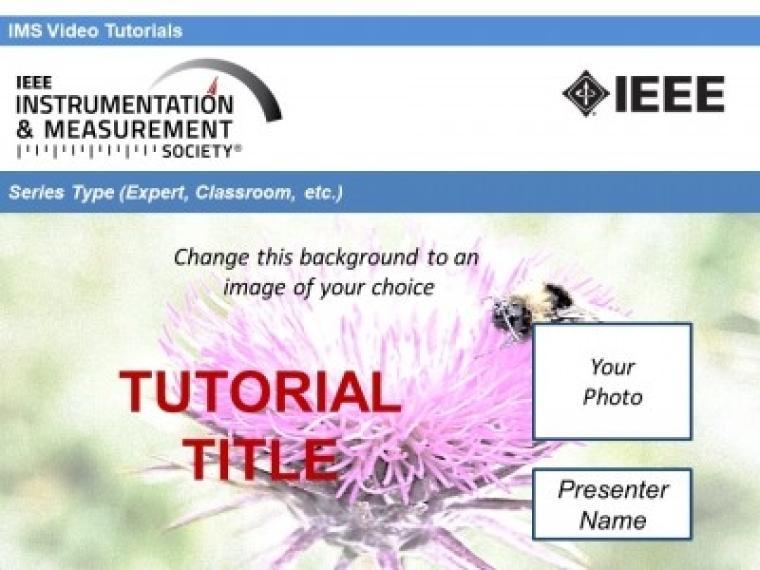
All videos will start with an initial (cover) slide, which may be downloaded here. The cover slide can be tailored to the presentation topic but must include the following information: Presenter Name, Presenter Photo, Tutorial Title, and Series Type. The options for Series Type are:
- Expert: An Expert series Video Tutorial is one typically authored by an Author who is recognized as an Expert (academician or practitioner) in his/her field.
- Classroom: A Classroom series Video Tutorial is one typically authored by a graduate student and may be geared more towards specific measurement or instrumentation skills and/or classroom-based lecture topics.
An example of the slide is shown below in Fig. 1.
The last slide of the presentation must contain a reference list to assist interested viewers with further investigation of the topic.
The Video Recording Session
The video can be recorded either during recording sections that coincide with conferences (such as I2MTC), or recorded directly by the author(s) themselves. When the recording will occur during a conference, each author will be informed in advance of the recording location and schedule. These sessions are primarily intended for conference attendees, and no financial support for travel expenses, conference registration, etc., is available.
Videos other than the ones recorded during conferences will be recorded by the authors, who will need to record and edit the final video.
The EIC will organize the recording session. The location of the session will be established by the EIC. A Recording Service Supplier (RSS) will take care of the recording sessions. The RSS will be in charge of providing all required video recording resources and post-processing the videos.
The typical resources provided by the RSS are:
- A back-lighted screen;
- A lighting system capable of suitably lighting both the speaker, who will be allowed to move during the presentation and the screen.
- A microphone system for voice recording.
After video recording, the RSS will be in charge of the video post-processing. A first release will be provided to the EIC. After completion of this phase, the edited video will be sent to the Author for approval (provided within two weeks of receipt of the video) and will be allowed to request further minimal changes. Such requests, if relevant to the video quality, will be forwarded to the RSS for final video editing, but are not guaranteed to be implemented. The final version will be sent back to the author for final approval. At this time, she/he will provide the filled and signed corresponding Consent and Release form, a list of keywords, a CV, and, if relevant, the Assessment Question List.